Building Knowledge
Art History classwork turns into a unique professional opportunity, giving four UW–Madison students new perspective on what makes a neighborhood.
By Julia Walkowicz, Division of the Arts
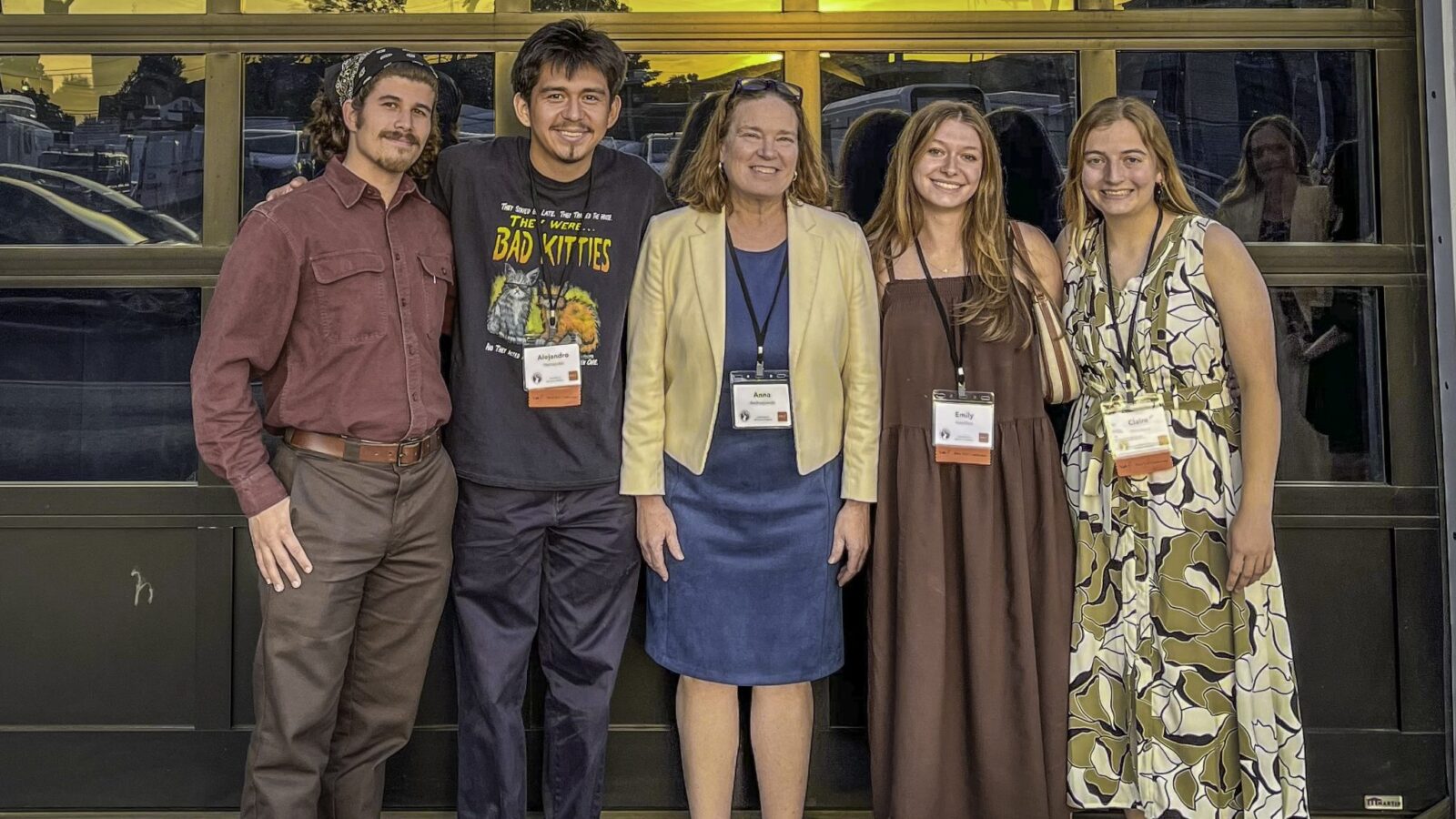
Prof. Anna Andrzejewski (at center) with all four UW–Madison student ambassadors at closing night of the conference. Pictured L-R Jack Taylor, Alejandro Hernandez, Emily Hamilton and Claire Wendland. Photo courtesy of Andrzejewski
When Claire Wendland traveled to Walla Walla, Washington, for an architecture conference this spring, she didn’t know what to expect.
For starters, when she and three of her fellow seniors from Professor Anna Andrzejewski’s art history class took to the historic downtown streets for a walking tour, they were met by a surprising guest: renowned architectural historian Thomas Hubka.
“We read his [work] in class — and he was actually there,” Wendland says of Art History 457: History of American Vernacular Architecture and Landscapes. “While we were exploring the neighborhood and looking at the houses that were part of the conference, he would even test my knowledge sometimes, and it was really cool to show what I learned.”
That was just the beginning for Wendland, Alejandro Hernandez, Emily Hamilton and Jack Taylor — all UW–Madison seniors at the time from various majors, including interior architecture, anthropology, urban planning, and art history. They were each awarded fellowships to the Vernacular Architecture Forum, one of the only organizations in the country that invites undergraduates to its conference as “ambassadors.”
The rare opportunity — with fully funded travel — was made possible by Andrzejewski, who’d presented at this same conference in 1995 when she was just starting graduate school. She says at first she was intimidated by so many renowned faculty in one place, but that it ended up being so invaluable that she wanted her students to experience it, too.
“I remember vividly making connections, especially one connection with somebody who ended up being on my dissertation committee,” says Andrzejewski, adding that three of her graduate students also presented at this year’s conference. “Seeing my students, especially interacting with Tom Hubka, it was like recreating what I went through. This was a space where they could come together and co-learn. It’s strangely non-hierarchical, because you’re going out and experiencing these buildings together.”
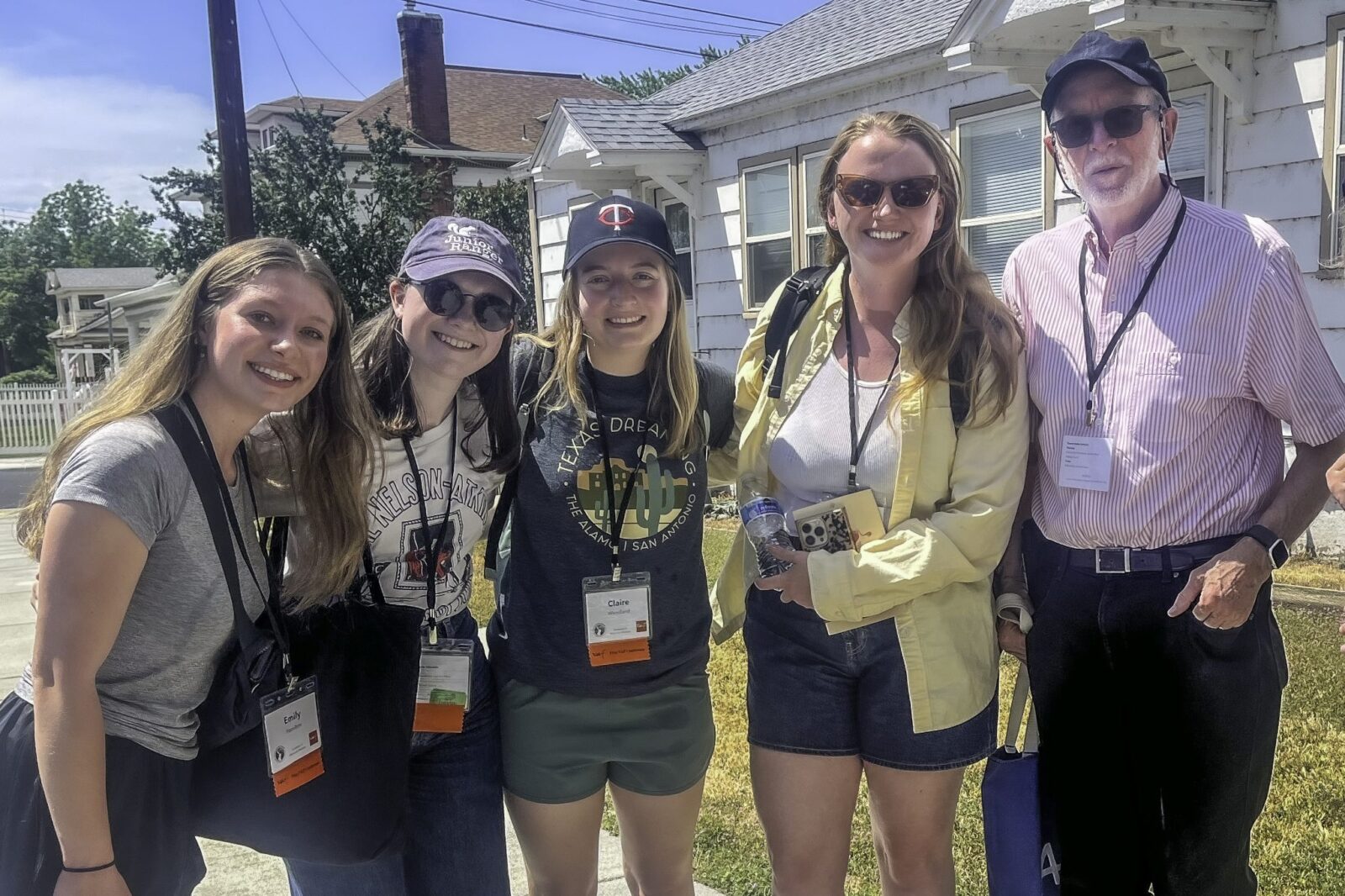
Architectural historian Prof. Thomas Hubka (pictured far right) joined several students in the field to practice “reading from the street” during a conference. Photo courtesy of Anna Andrzejewski
Bringing it back to Wisconsin
Andrzejewski’s students had already been practicing concepts covered at the conference, including Hubka’s “reading from the street,” detailed in his book “Houses Without Names.” Standing on the sidewalks of Madison’s iconic West Mifflin Street, students noticed things about the buildings that others might walk right past. In class, the neighborhood became a laboratory for analyzing construction materials, architectural styles and predicting layouts to better understand how the neighborhood has changed over time. Vernacular Architecture is like putting together a puzzle — each building tells you a little bit more about a larger story.
“‘Reading from the street’ is taking these little physical cues, and trying to figure out what it means for the floor plan, what it meant for the time in which it was built, why it is the way that it is, and then maybe what changes it’s experienced over time, too,” says Hamilton, who majored in Design, Innovation and Society in UW’s School of Human Ecology. “I’ve always loved the idea of ordinary architecture, but I didn’t really have a word for it until I met Anna.”
For Taylor, an anthropology and Landscape and Urban Studies double major with certificates in Archaeology and Chicanx/e and Latinx/e Studies, it’s about understanding the people of a given neighborhood. After all, buildings are not just houses, they are homes.
At the conference in Washington, he learned about cultural and historical forces that shaped the city’s buildings. While he was expecting to learn about architecture, he was surprised how connected the trip was to his other majors.
“We were basically studying the evolution of that area, and then viewing it through different lenses like student housing, separate community areas, and the meaning it’s had in protest movements in the past,” says Taylor. “A lot of the demographic dynamics that I was learning about in my Chicano Studies program were entirely relevant.”
Hernandez, too, is most interested in understanding the people inside the buildings. As an Art History major with secondary majors in political science and Spanish, he used the conference to help decide what to pursue in graduate school. “My research interests have always revolved around highlighting and presenting the histories of marginalized communities to a forum where they have historically been ignored,” Hernandez says. “This conference not only made me realize that this is possible at a larger scale, but it also provided a framework through which I can more visibly see how to work these communities into academic research.”
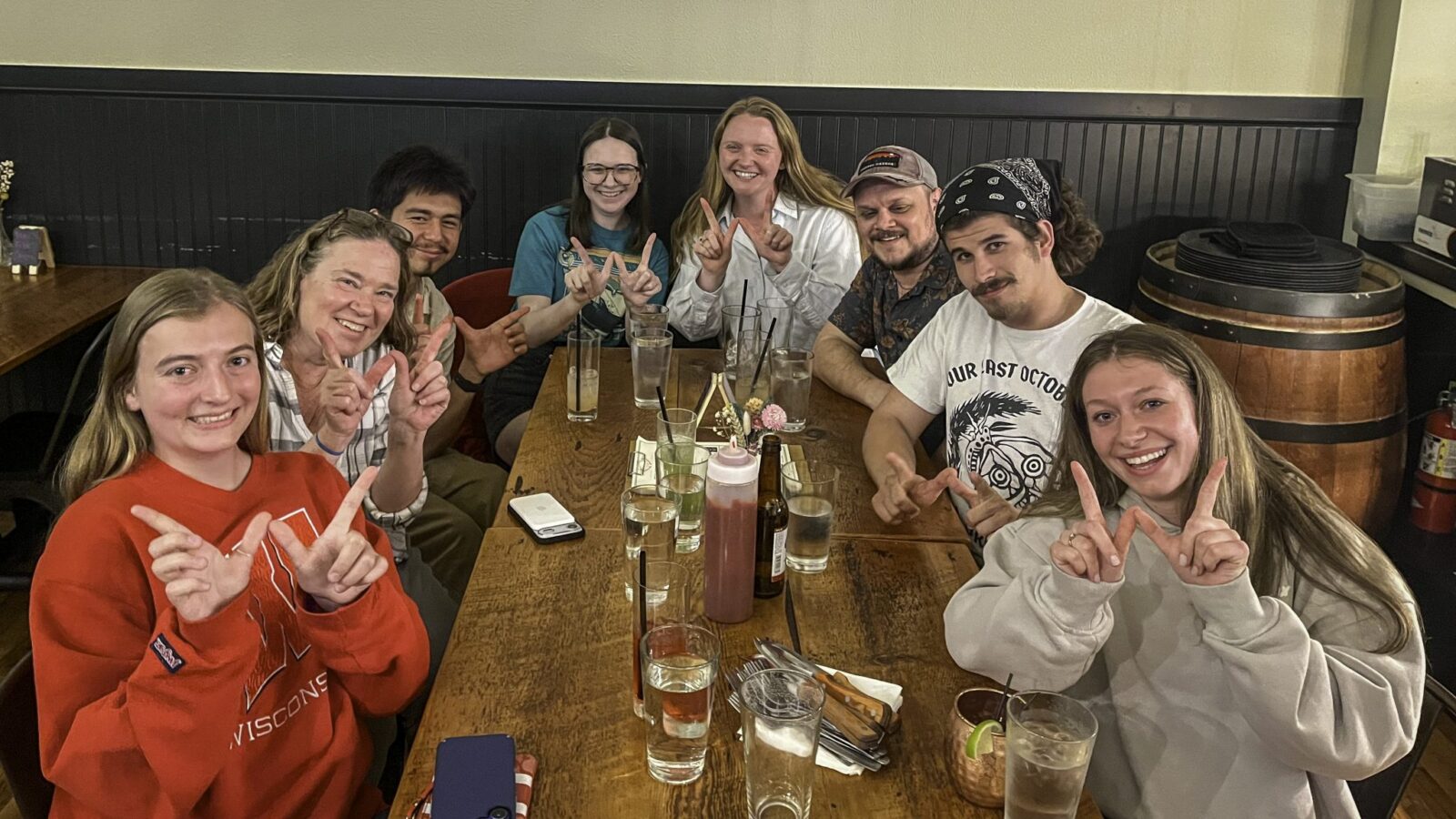
Three of Prof. Anna Andrzejewski’s graduate students who presented at the conference joined her and all four undergraduate ambassadors for dinner in downtown Walla Walla. From left to right: Claire Wendland, Anna Andrzejewski, Alejandro Hernandez, Sophie Applegate, Laken Sylvaner, Travis Olson, Jack Taylor, Emily Hamilton. Photo courtesy of Andrzejewski
A foundation for the future
The conference offered students the opportunity to network with professionals in architecture and art history — helping them to visualize what their careers could look like after college. Despite walking in-step with experts twice their senior, the students felt that they were treated as equals with all guests coming together to bond over a shared passion for architecture.
“What was really cool about this conference is there were people from so many different fields,” says Wendland, who graduated with a degree in interior architecture with two certificates: one in architecture, and the other in sustainability. “As an architect you’re kind of programmed to think about just architecture, not say, what a historic preservationist would think about. Having many different perspectives and fields included in the design process will only make the design better.”
“I would say the conference was life changing, honestly,” says Hamilton, who currently interns at a tile design company and is pursuing interior design. She especially appreciated the exposure to a variety of perspectives at the conference.
“You wouldn’t think that people from majors, like computer science or economics, would be interested in architecture, but at the conference there were people talking about research from all different kinds of fields,” says Hamilton. “I think it’s really cool to see what draws people in, like, why people find architectural preservation so exciting. Everyone had their own lens of looking at things and their own types of questions. When you have everyone’s eyes on one object, it’s easier to notice a lot.”
As for Taylor, he took a field archeologist job at the Wisconsin Historical Society after graduating this spring, and will probably apply to graduate school in archeology or heritage preservation.
“It was just a luxury to actually meet people with careers, either academic or professional, in art history, which is something that I haven’t had a lot of exposure to yet,” says Taylor. “It broadened my horizons a little bit, my view of what is possible with my interests.”
This is just what Andrzejewski had in mind for her students, and what she hoped they’d get out of the conference opportunity.“ The students come from different parts of campus with different career goals, but all have latched onto vernacular architecture studies as something important to their future,” Andrzejewski says. “This was a really special opportunity for them beyond the campus level. I think it gives them confidence, but also an exposure that will really help them shape their future.”
Andrzejewski’s students come from different areas of the country and are headed into different careers, but one thing is certain: wherever they end up, they’ll all know how to “read from the street.”
Julia Walkowicz is a student writer for UW–Madison Division of the Arts.