A perfect storm
How students teamed up with professors from Atmospheric and Oceanic Sciences and Mead Witter School of Music to transform Wisconsin weather into musical performance.
By Julia Walkowicz, Division of the Arts
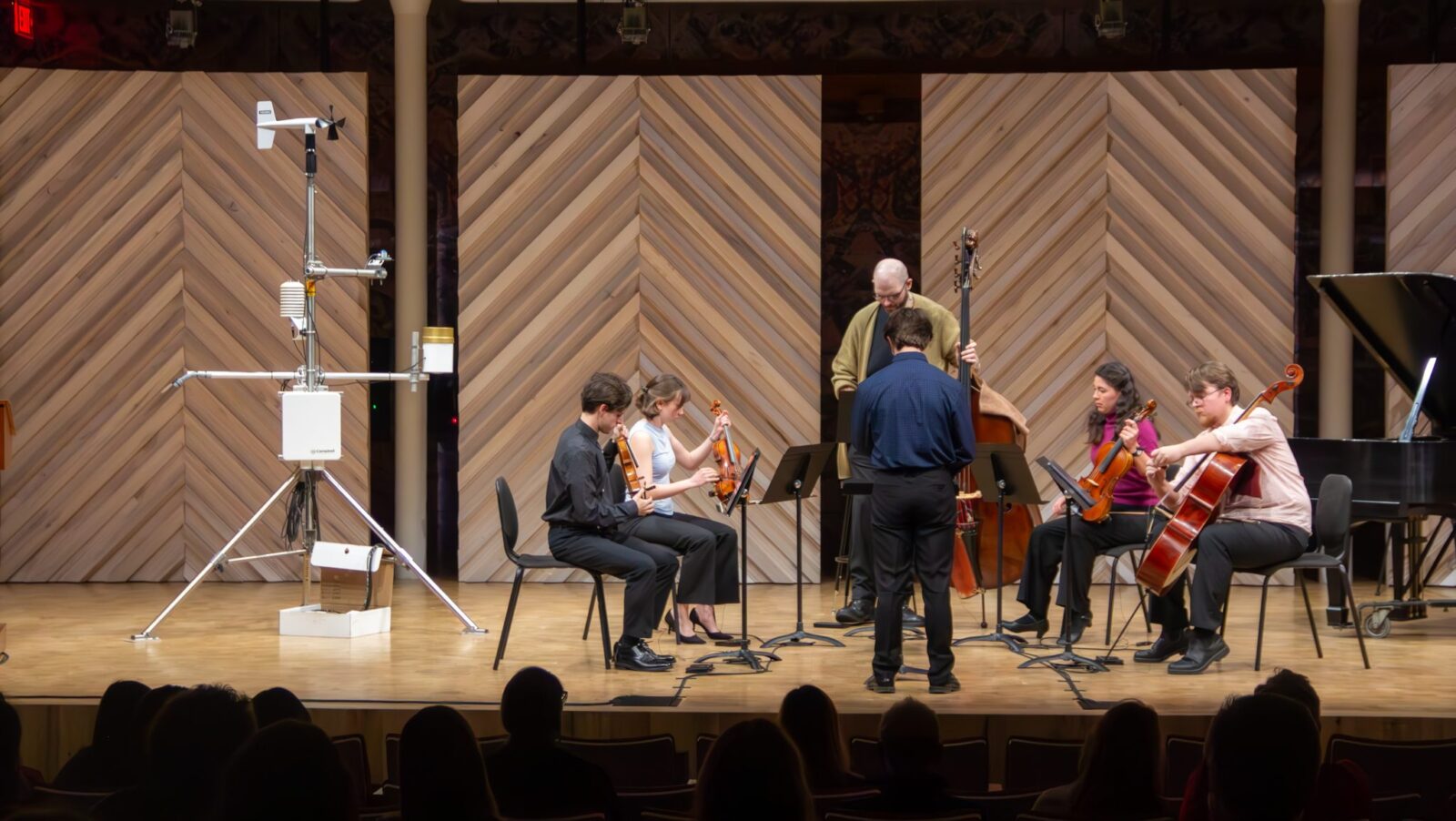
When Molly McKellar saw an email inviting students to turn Wisconsin weather data into composed music, the opportunity felt too perfect to pass up.
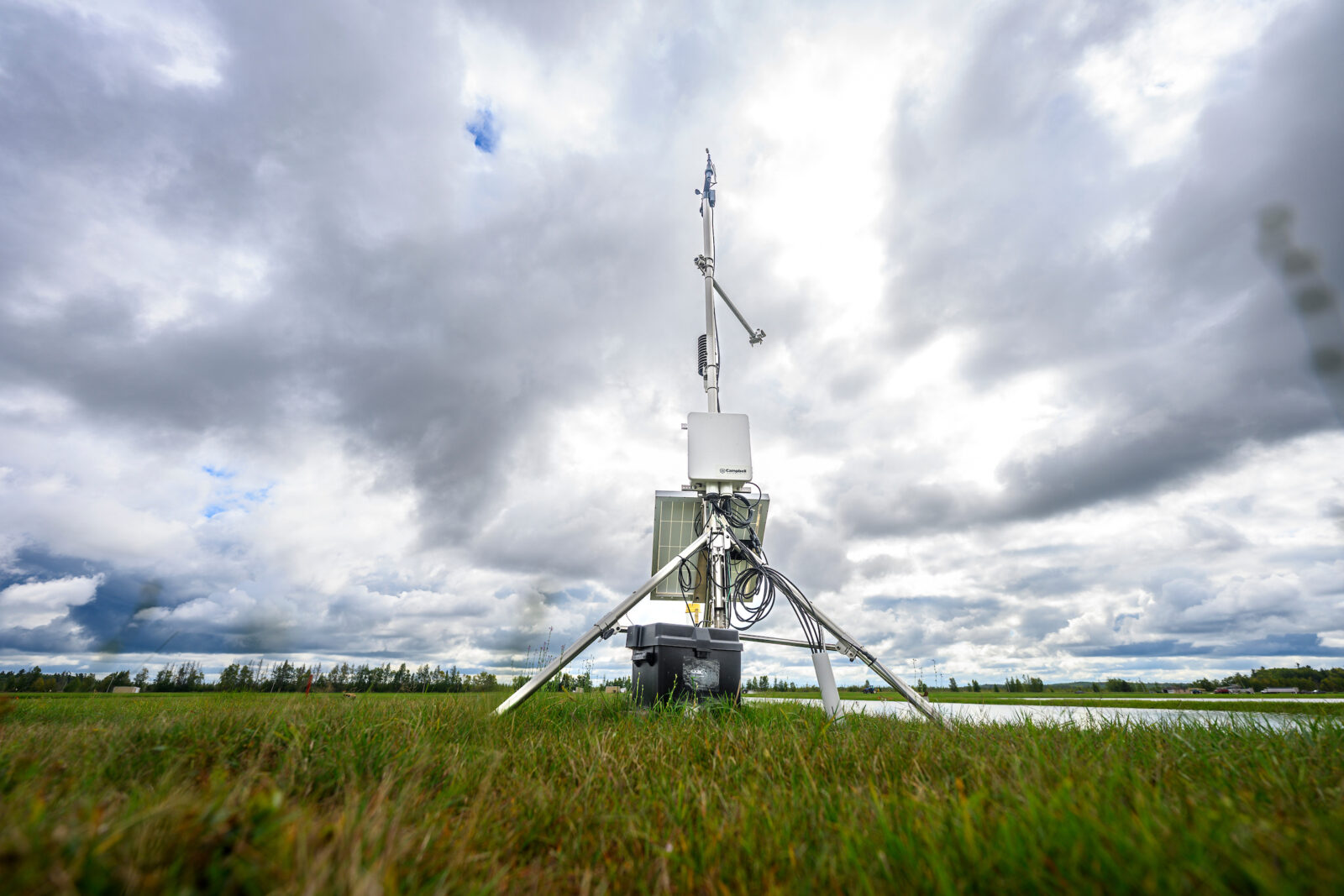
McKellar, a senior studying Atmospheric and Oceanic Sciences (AOS) at UW–Madison, is well-versed in understanding Wisconsin weather. She worked as a student field technician for the Wisconsin Environmental Mesonet, better known as Wisconet. It’s a growing network of over 78 weather monitoring stations across Wisconsin, each providing more than one dozen measurements every five minutes.
McKellar started working at Wisconet her sophomore year of college, traveling across the state to install weather stations. But there was another reason that email caught her eye: McKellar has played viola since middle school.
“I just got really lucky,” she says. “It was a merging of all of my interests and everything I’ve been a part of on campus.”
In Search of New Connections
The email had come from Assistant Professor of Atmospheric and Oceanic Sciences Elizabeth Maroon, who was in her second year of collaborating with Mead Witter School of Music Johannes Wallmann on a project called “Earth Signals” to help general audiences better understand science.
Like many experts, Maroon had been holding public lectures to share her research more widely and help educate the community. But she noticed a pattern.
“When I would give talks, it would be the same few people who would always show up, and they already knew everything. So I was like, ‘How do we reach new audiences?’” says Maroon. “What if we did something where we’re making new music from data, and we had students doing the composing — and then we had a concert at the end to both share the new music and educate about the science?”
Maroon tapped AOS major Hunter Glassford to help conduct a process called sonification — essentially turning weather data into sound — inspired by El Niño forecasts. Wallman enlisted music composition Ph.D. candidate Ben Ferris to compose and perform with UW Bridge Ensemble, and “Earth Signals: El Niño — a science-inspired musical experience” premiered in April 2025.
Earth Signals, take two
McKellar signed on to the project for its second iteration in 2026. She took data collected by Wisconet and rounded data values to wholenotes on the C-major scale, then used a programming language called Python to translate these notes into a compositional score that could be understood by musicians.
“It was a little bit of a learning curve because I honestly wasn’t all that familiar with sonification,” says McKellar. “Our main goal was to be able to communicate weather to the public. We knew we should include cold fronts, but we felt it was important to talk about rain, sunlight and wind as well.”
After reviewing proposals from Mead Witter School of Music students, Maroon and Wallman selected a proposal from Chistopher Cobley, a DMA student in Music Composition. This proposal became his new composition, “Sonic Translations for String Quintet and Live Electronics.”
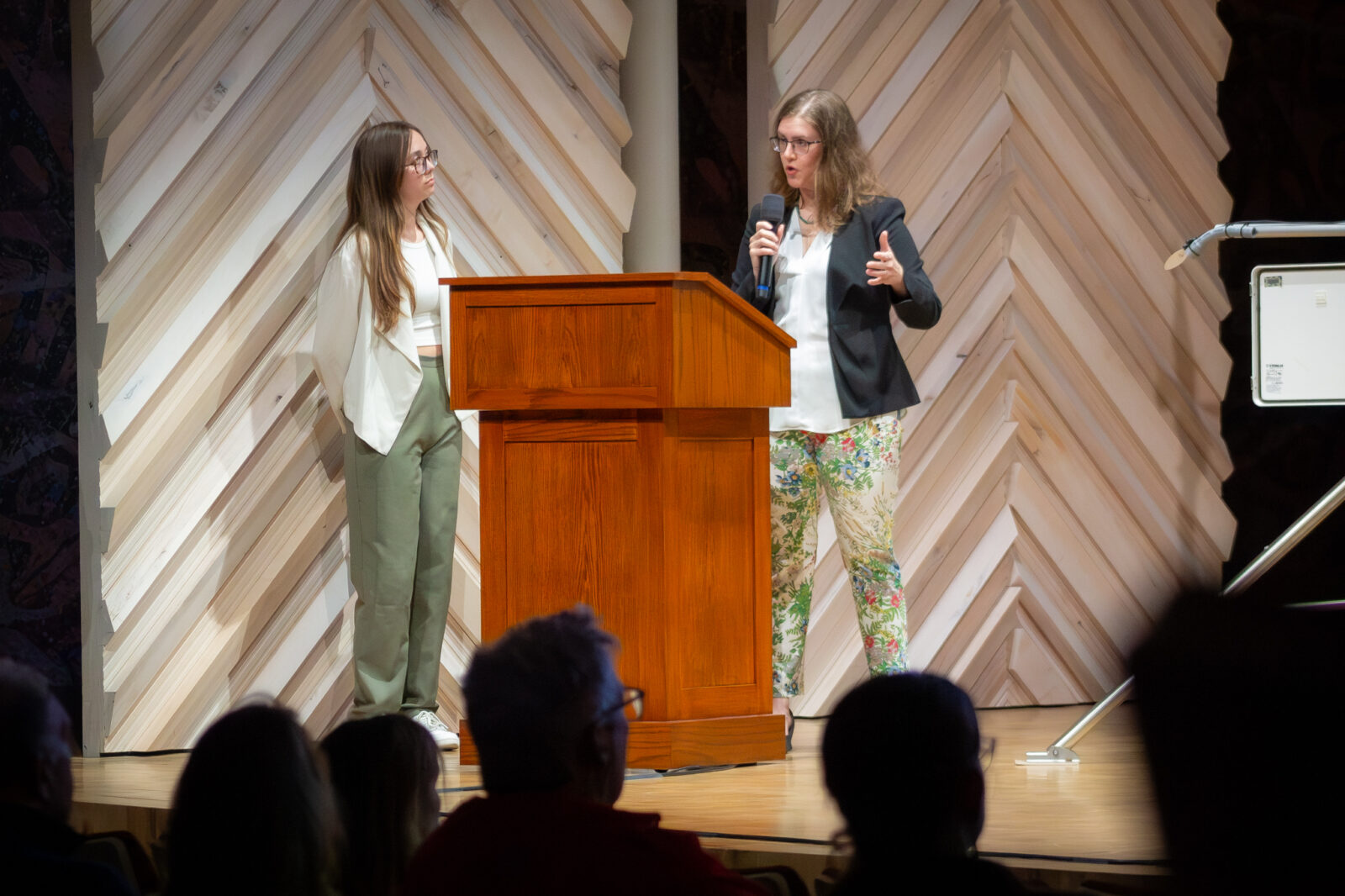
McKeller’s sonifications and Cobley’s new composition premiered at Hamel Music Center with a group of student musicians including McKenna Taylor, Sage Eckard-Lee, Anton Wachmann, Alexander Ferkey, Jared Sierra, and David Henry. From the stage, McKeller explained how she’d sonified weather data from Wisconet into four different sonifications focused on cold, rain, winds and solar radiation, and Cobley explained how he translated the same data into his composition. Then a string quintet played each corresponding translation composed by Cobley.
“Sonification data is raw, it can sound random, and it doesn’t always translate well to music,” Cobley says. “You have to kind of take the data and, rather than sonify it, translate it. I split the piece into four movements, and I wanted to use different translation methods for each movement to provide a bit of variety.”
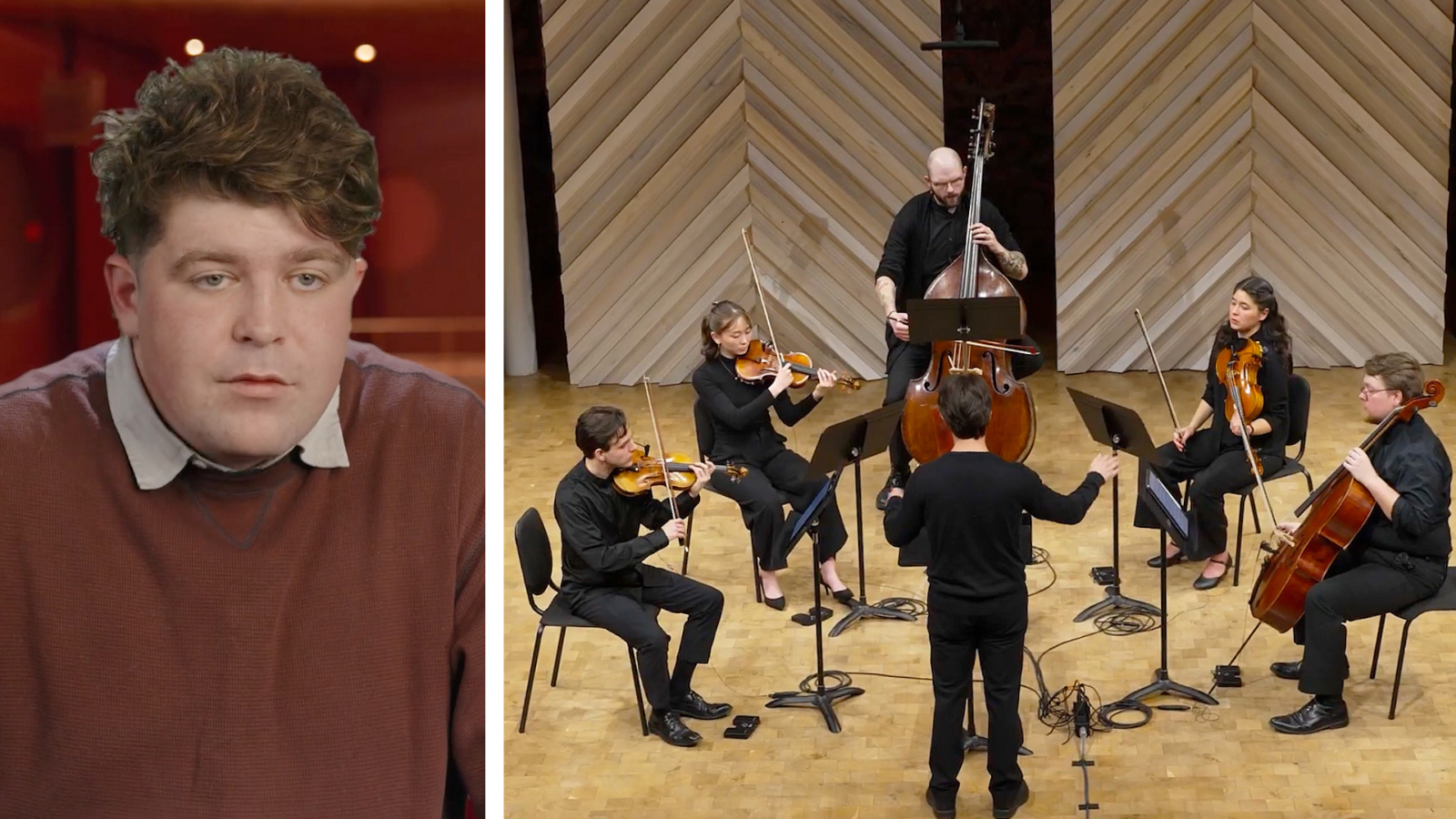
For example, the first translation, titled “Aeolian Drift,” looked at wind data. McKellar directed the audience to graphs that showed an extatropical cyclone pushing cold and warm fronts, dropping pressure and resulting in winds and rains across Wisconsin. One violin’s changes in pitch represented the temperature as it dropped lower and lower. Another violin brought to life crashing wind speeds as a viola sounded the shifting humidity. McKellar prompted the audience to “listen for the changes in pitch” to understand the tumult of the cyclone.
“I had a great time getting to work with the musicians and seeing how Chris interpreted the data, because I have a very different perspective on weather data than Chris,” says McKellar. “And so watching his thought process and how he used our data to make music was just really cool. I wouldn’t have gotten that experience any other way.”
With each of the remaining translations, the musicians used their performance skills and Cobley’s score to represent weather patterns, from soothing sounds to bright melodies to quicker tempoed, dramatic arrangements. When composing, Cobley aimed to find the sweet spot between holding true to the data sonified by McKeller and creating a piece which was musically appealing to the audience.
“I think that it’s necessary to provide a canvas on which the actual story can be told,” says Cobley. “When done correctly, music can tell a story, even though it doesn’t have words. In a way, that was better than words could have told it? Like, it’s almost like language was the fallible thing and that what you needed was music.”
Forecasting the Future
For McKellar, representing Wisconsin weather through musical composition felt like an important chance to help the public understand science in a new way — just as Maroon had hoped.
“I think that communicating our sciences has historically been a big problem, and so introducing it in a musical sense helps to connect with new audiences,” says McKellar. “And if they don’t know as much about weather, this gives them the opportunity to bridge that gap by using something that people already know a lot about. Presenting it in the musical format just gives us another opportunity to connect with broader audiences.”
McKellar says working on the project Earth Signals was not only unexpected, it also helped clarify the importance of Wisconet. It’s an experience she’ll carry long into her future.
“I’m going to be graduating in less than a month so this is one of the last things that I did at the university, which is crazy to think about — as a student sometimes, you get lucky,” says McKellar, who plans to pursue a master’s degree in Atmospheric Sciences back in her Colorado hometown, where she’ll also likely keep playing music. “Being a part of the AOS community has really given me different opportunities to explore what I could do with my passion in the future.”
Julia Walkowicz is a student writer for UW–Madison Division of the Arts.