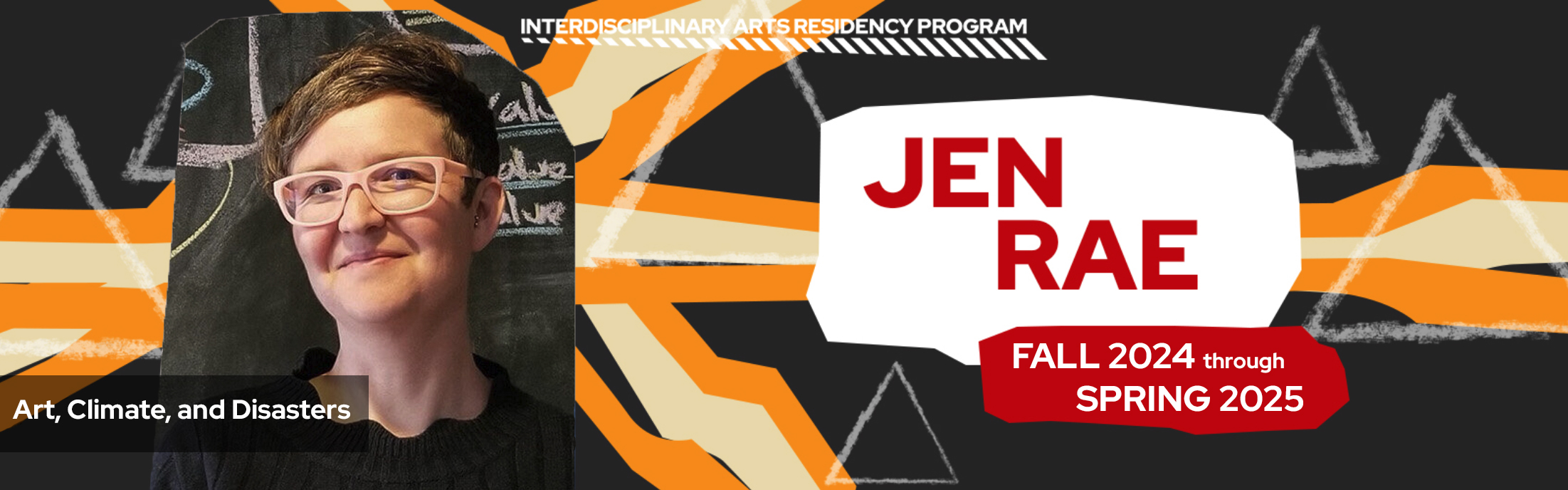
2024-2025 Jen Rae
Jen Rae is a renowned interdisciplinary artist who was UW–Madison’s Artist-in-Residence for the ’24-’25 academic year.
The arts have been extensively drawn upon in over the past decade to support communities devastated by wildfires, floods, storms, and drought, and more recently the COVID-19 pandemic. However, there is still much that is not known about arts and culture in disaster contexts including risk reduction, preparedness and response. Frequently perspectives from diverse and equity-denied groups (e.g. First Nations, youth, LGBTIQA2S+, disabled and multicultural, etc.) as well as from other sectors (e.g. arts & culture) are underrepresented in climate emergency and disaster management research, discourses, planning, and events. These groups assess risk differently and offer alternative expertise, perspectives and experiences that are beneficial to understanding and engaging with the cultural dimensions of the climate emergency. Jen Rae’s work explores the intersections of creative practice and transdisciplinary collaboration in disaster scenario mapping and preparedness in a localized context through individual and collaborative exercises.
About the Artist
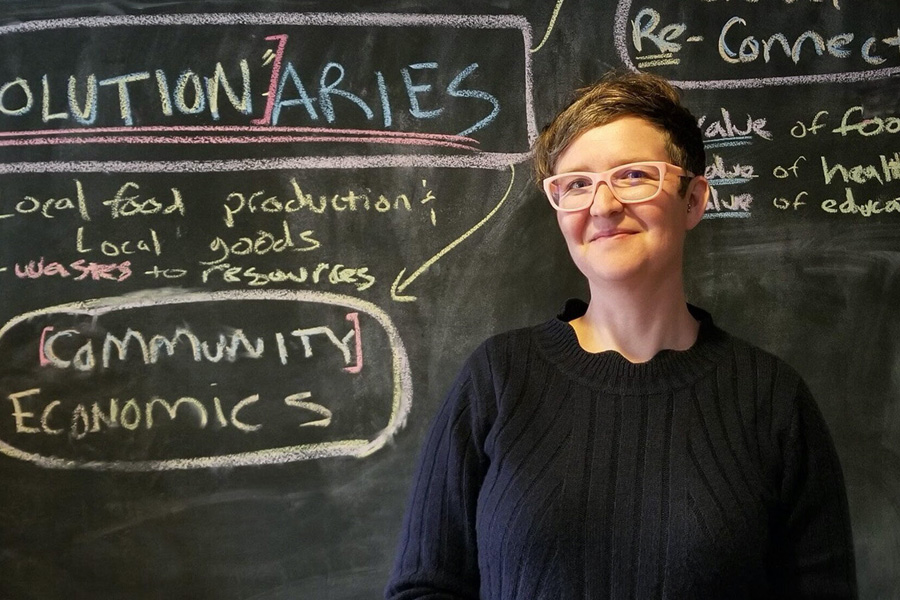
Dr. Jen Rae is an award-winning artist and researcher of Canadian Scottish-Métis (Indigenous) descent living on unceded Djaara Country (Castlemaine) Australia. She is recognized for her practice and expertise situated at the intersections of art, speculative futures and climate emergency disaster adaptation + resilience – predominantly articulated through transdisciplinary collaborations, multi-platform projects, community alliances and public pedagogies. She is the Co-founder and Creative Research Lead at the Centre for Reworlding, Co-founder(with American artist Dawn Weleski of Conflict Kitchen) and Director of Fair Share Fare, a member of the National Task Force for Creative Recovery, and was awarded a prestigious 2023 Creative Australia Fellowship for Emerging and Experimental Art.
Jen creates and contributes to experimental multi-platform collaborative projects balanced with professional mentoring of other artists, public talks, workshops and deep socially-engaged projects with diverse partners and communities. Most relevant is her role as a core artist of Arts House’s prescient REFUGE project (2016-2022) – where artists, emergency service providers and communities worked together to rehearse climate-related emergencies exploring the impact of creativity in disaster preparedness. Relevant projects during REFUGE include the speculative fiction short film REFUGIUM (co-written with Claire G. Coleman); PORTAGE: SHELTER2CAMP in collaboration with 4 First Nations master weavers to co-build 6 life-size disaster shelters with over 120 community participants and partners; the FIRST ASSEMBLY OF THE CENTRE FOR REWORLDING event; and, the art exhibition RESURGENCE. All are grounded in First Nations knowledge systems and protocols, exploring themes climate, colonisation, disaster preparedness and intergenerational justice.
Guest Artists
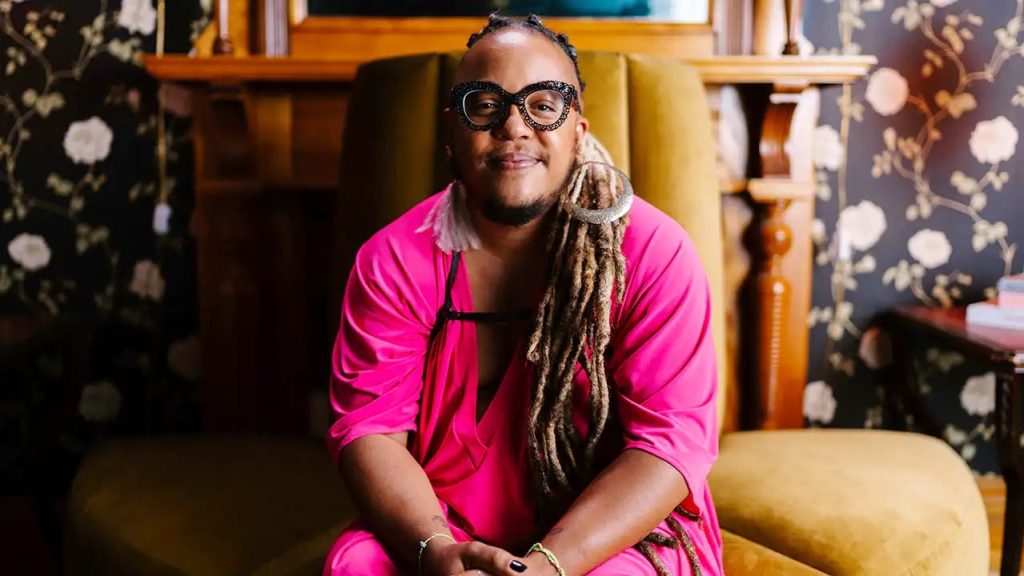
Syrus Marcus Ware is a Vanier Scholar, visual artist, activist, curator, and educator. Using painting, installation, and performance, Syrus works with and explores social justice frameworks and Black activist culture. His work has been shown widely, including solo shows at Grunt Gallery in 2018 )2068:Touch Change) and Wil Aballe Art Projects in 2021 (Irresistible Revolutions). His work has been featured as part of the inaugural Toronto Biennial of Art in 2019 in conjunction with the Ryerson Image Centre (Antarctica and Ancestors, Do You Read Us? (Dispatches from the Future)), as well as for the Bentway’s Safety in Public Spaces Initiative in 2020 (Radical Love). Syrus has participated in group shows at the Never Apart in Montreal, the Art Gallery of Ontario, the University of Lethbridge Art Gallery, the Art Gallery of York University, the Art Gallery of Windsor, and as part of the curated content at Nuit Blanche 2017 (The Stolen People; Won’t Back Down). His performance works have been part of festivals across Canada, including at Cripping The Stage (Harbourfront Centre, 2016 & 2019), Complex Social Change (University of Lethbridge Art Gallery, 2015) and Decolonizing and Decriminalizing Trans Genres (University of Winnipeg, 2015).

Dawn Weleski co-founded Conflict Kitchen, a take-out restaurant serving cuisine from countries in conflict with the U.S. Their art practice tests cultural norms, transforming protests and public offices into social stages. Notable projects include City Council Wrestling, where citizens and officials became wrestling characters representing their political passions, and Refuse Refuse: Radio, a climate-focused radio series supported by the Anonymous Was a Woman Environmental Art Grant and NY State Council on the Arts, which dramatizes survival stories in rural New York.
With over 25 years in hospitality, Weleski also co-leads emergentCNY, a mutual aid network in Central New York, which uses a repurposed ambulance to share stories of aid and resilience. Currently the Student Life Sustainability Artist in Residence at the University of Michigan, they co-initiated Noon at Night, a solidarity network of transgressive learners bonded by food and collective resilience.

Katia Tynan is a leader and relationship-builder who currently leads the Resilience and Disaster Risk Reduction team at the City of Vancouver. Katia oversees the implementation of the City of Vancouver’s Resilient Vancouver Strategy (2019) and the more recently led the development of Vancouver’s Hazard, Risk, and Vulnerability Analysis (2024), both of which advance the city’s understanding of risk and resilience in municipal planning. Her work has advanced disaster risk and climate change adaptation governance and collaboration across departments and intergovernmental working groups. Katia works tirelessly to amplify the voices and needs of communities disproportionately impacted by disasters and emergencies. Through the Resilient Neighbourhoods Program she has established partnerships with over 25 community-based organizations to deliver essential services to their communities for extreme heat and wildfire smoke events.
Katia holds a BA in Geography and Political Science, an MA in Disaster & Emergency Management, a certificate in strategic foresight, and is currently working towards her MSc in Health Equity and Sustainability. She has extensive experience in research, planning, program management, and hands-on response efforts. Her person-centred, community-building approach is reflected in her work at the local and the global level as a member of the Resilient Cities Network. You can find Katia’s thoughts on the importance of integrating artists in emergency management and disaster risk reduction here.