From design degree to Fortune 500 company
By Maggie Ginsberg, Division of the Arts
UW–Madison’s Master of Science in Design and Innovation degree is the perfect—and perfectly marketable—blending of art, engineering, and entrepreneurship.
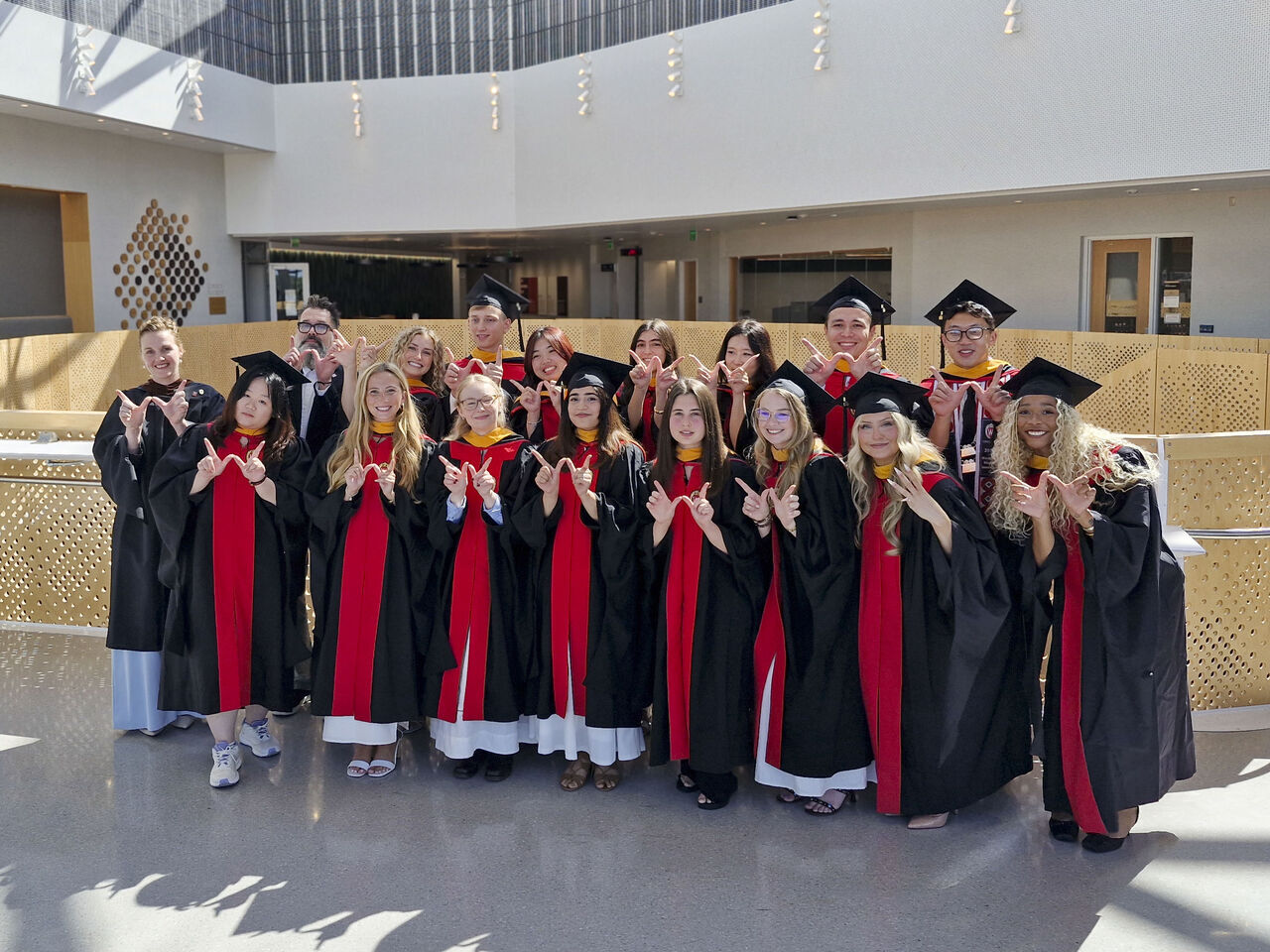
2025 MD+I graduates with instructors Trudy Watt and Coe Douglas. Photo courtesy of Lucy Murdock
When Trudy Watt is explaining UW–Madison’s Master of Science in Design and Innovation program (MD+I), an image floats across her mind.
First she pictures her current cohort, a dozen or so UW graduate students from all walks of undergraduate degrees or early careers. They’re gathered in an MD+I classroom brainstorming creative solutions to real-world projects, often with the stakeholders in the room — maybe a representative from Southwest Airlines, or a local government official working on housing issues.
This happens regularly as part of the 12-month, immersive, professional graduate degree program.

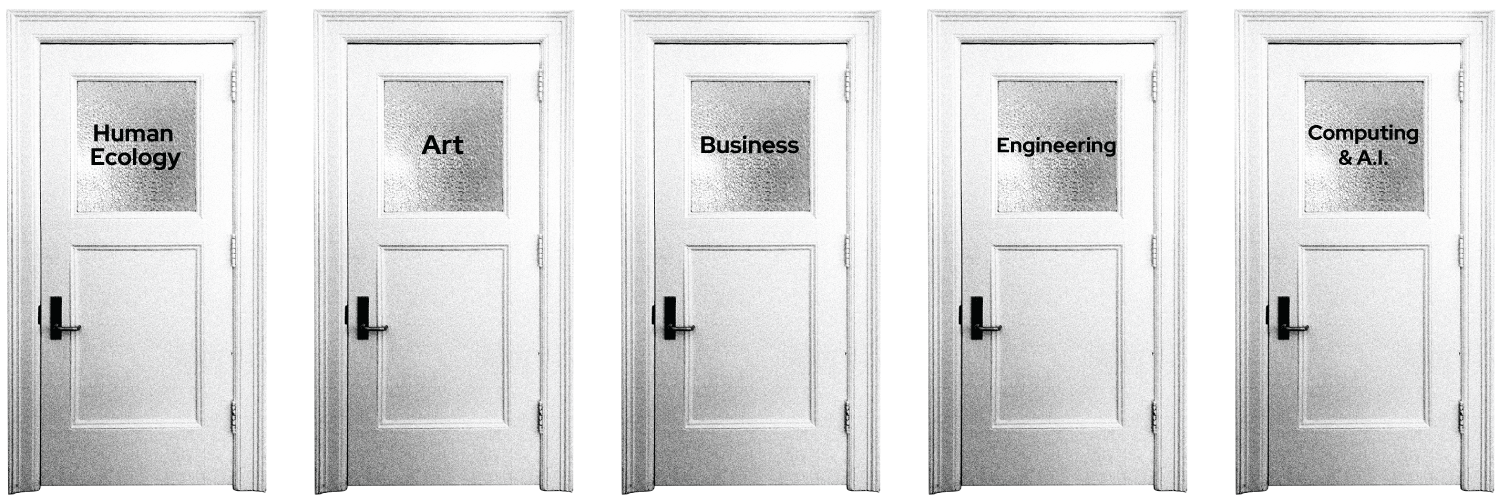
But then Watt imagines the classroom suddenly opening into a secret hallway system. Her students run through make-believe halls and pop out at any one of MD+I’s five real-life campus partners: the School of Human Ecology, the UW Art Department, the Wisconsin School of Business, the College of Engineering, or the College of Computing & Artificial Intelligence.
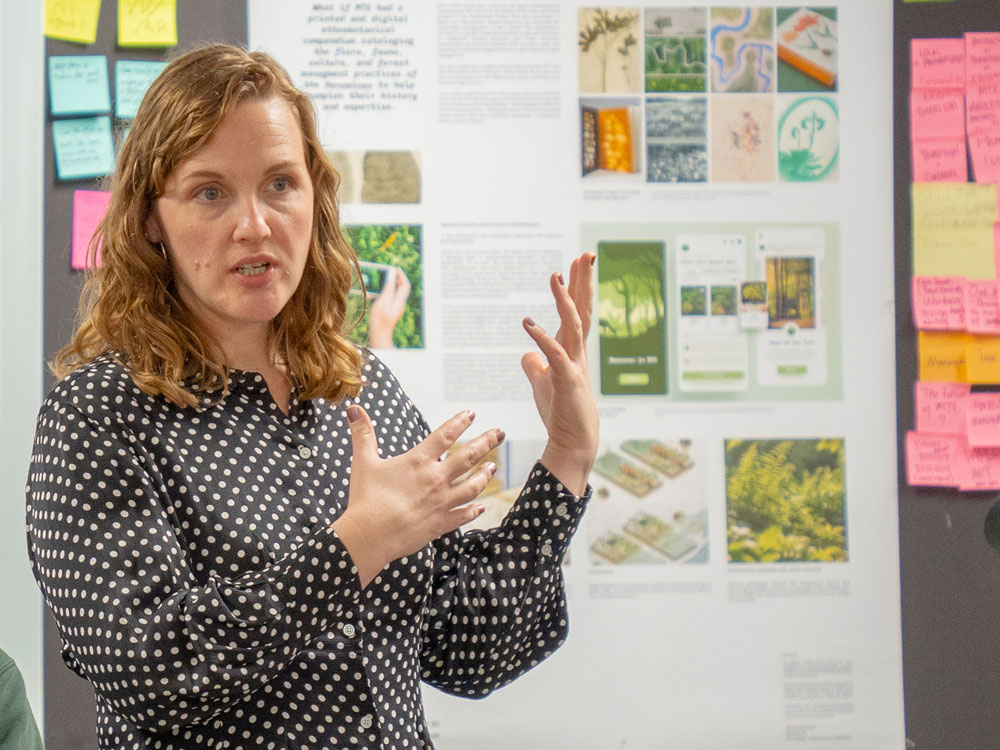
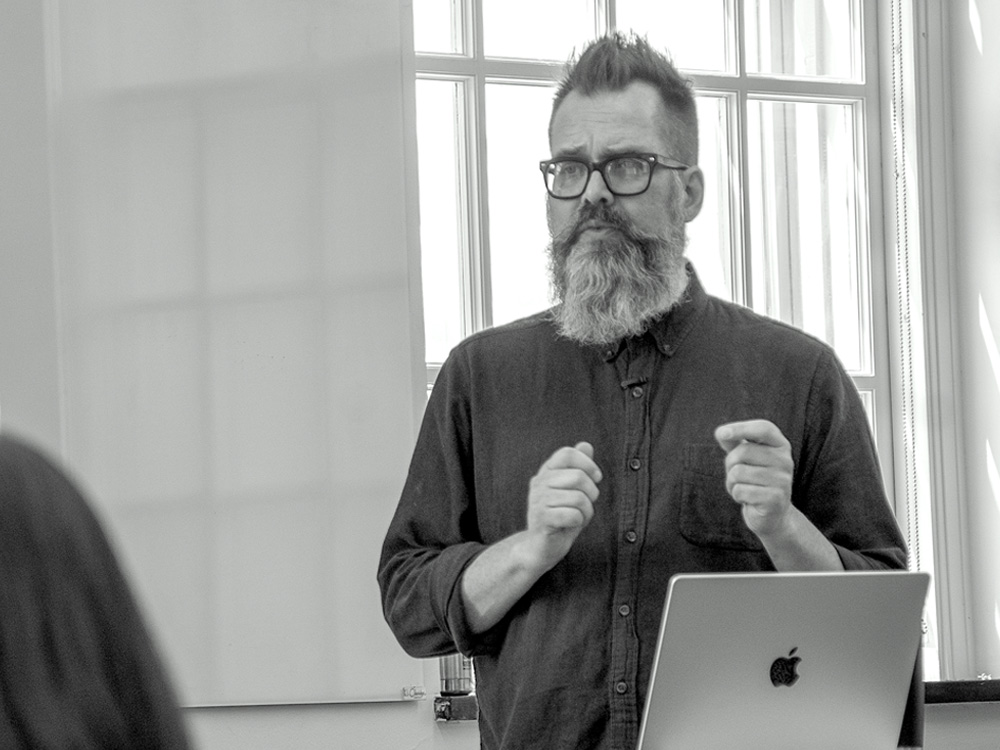
“There isn’t another program I’ve ever found that exists at the confluence of five schools and colleges on a campus,” says Watt, who serves as academic director of MD+I alongside creative manager and instructor Coe Douglas. The secret hallways are just a visual image used to communicate a complex idea, not unlike the ones MD+I students create as part of their coursework. But the fact that MD+I is shared by five UW–Madison schools and colleges is very real — and Watt isn’t aware of anything quite like it.
“We’re radically interdisciplinary,” Watt says.
MD+I doesn’t require a specific prerequisite degree, so it attracts creative thinkers from all disciplines and career stages. Some students are fresh out of undergrad, like UW–Madison class of 2024 graphic design alum Lucy Murdock, who earned her MD+I degree in 2025 and immediately took a job as an associate partner engagement specialist at IBM. Others are making a career pivot, like engineer Marlaina Kaine, who after 18 months working at Epic Systems, went back to school and earned the MD+I graduate degree — then was snapped up by the City of Pittsburgh as a Civic Innovation Specialist.
“We’re radically interdisciplinary,” Watt says.
In the coming year, Kaine will bring her acumen back to Wisconsin to begin a new job at Milwaukee Tool, the $10 billion manufacturer that describes its culture as “obsessed with disruptive innovation.” Kaine is the third MD+I alum hired by Milwaukee Tool in the last two years.
“The candidates with design backgrounds are kind of our bread and butter,” says Liesbeth Wenzel, vice president of design research at Milwaukee Tool. “The way that they approach problems is incredibly valuable.”
The art of finding a job
It’s an outdated stereotype that arts degrees don’t lead to jobs — and it simply isn’t true. Many of today’s companies are seeking innovative thinkers to solve proprietary puzzles in human-centered ways, and design and innovation degrees sit solidly at the intersection of art and engineering. According to a UW College of Engineering survey of 300 employers, 90% said they were seeking new hires who could work across disciplines and use design methods to solve problems.

“Growing up, I always wanted to be an artist,” says Murdock, who took every art class available to her throughout high school. At UW, she studied graphic design through the Art Department while pursuing a Design Strategy certificate through the School of Human Ecology. But she was on track to finish her undergraduate degree in just three years, and she wanted the full four-year experience at UW–Madison. She got accepted into MD+I, leaving a year later not only with both an undergraduate and a graduate degree, but also an unexpected level of pre-professional skills.
“I think what’s amazing about this program is how much work experience it gives you,” says Murdock. “The job market is hard right now. So to be 22 and stepping out of my fourth year of college and into an associate-level position at IBM means that I’m coming in with a level of experience that I could not have had with just my undergraduate degree.”
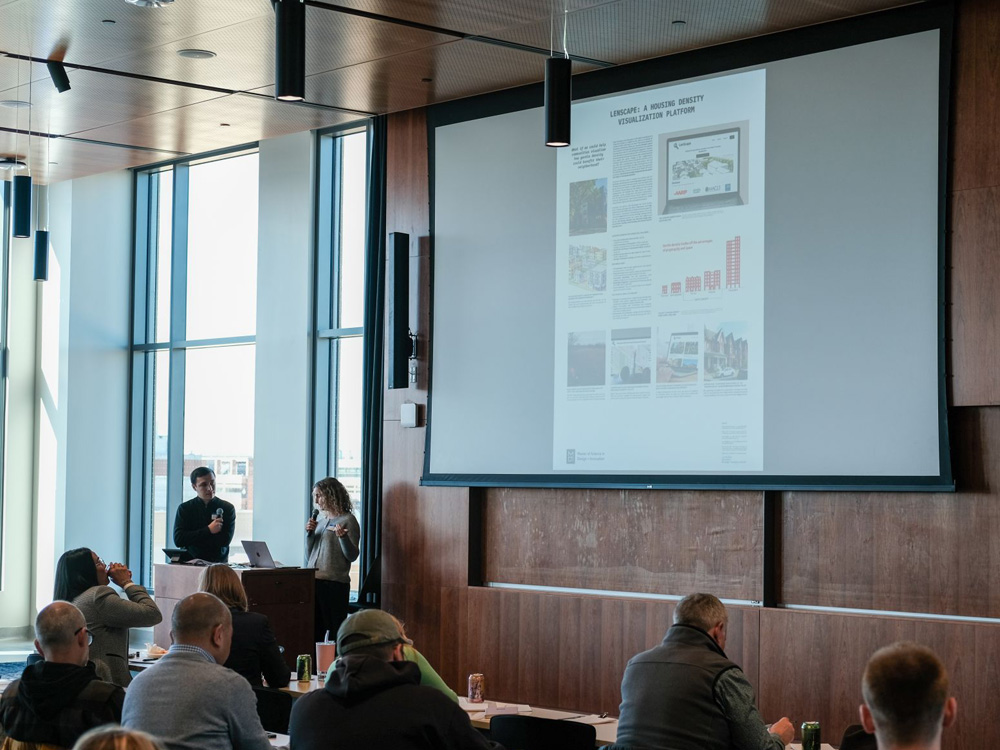
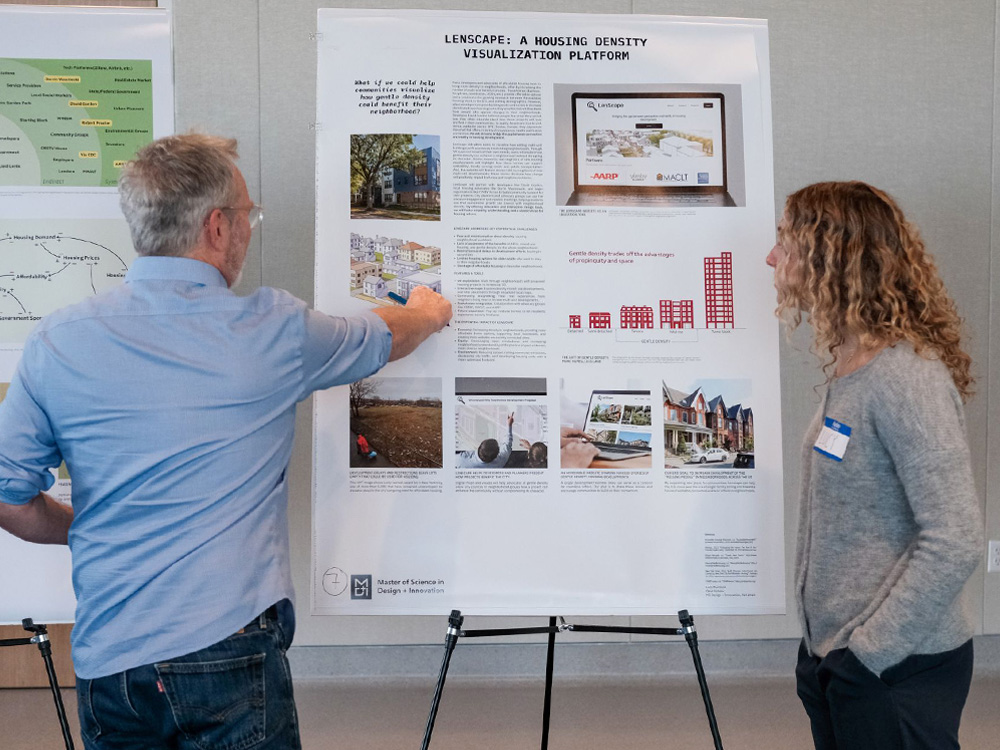
Lucy Murdock gives her fall design presentation in front of a panel of judges. Photos courtesy of Lucy Murdock
During the MD+I program, Murdock worked with organizations like Starting Block Madison, AARP Wisconsin, Madison Area Community Land Trust, and the Milwaukee-based nonprofits VIA CDC and CR8TV House. She and her cohort strategized housing issues and community improvement, operating with the understanding that these stakeholders could become actual partners one day. They showcased their work by presenting to industry professionals at events like the MD+I Design Horizon Symposium, the Wisconsin Housing and Economic Development Authority (WHEDA) conference, and even global architecture and design firm Gensler.
IBM noticed.
“To be able to have that real experience is why I have this job,” Murdock says. “Those basic hard skills show up in my job all the time — but I actually think the bigger thing is the soft skills that I learned through the program.”
Take, for example, the way the first semester of MD+I is entirely focused on not solving the problem. Rather, students are taught to first try to understand and define it; to research and ask questions, to observe and listen deeply, and to resist jumping to conclusions. It can be harder than it sounds, especially for ambitious, solutions-oriented students.
“It taught me the value of listening to feedback and being ready to shift and change all the time,” Murdock says. “I think it shows in my work here as a strength, that I’m ready to constantly pivot, and that’s all design-thinking strategy.”
Returning to the Classroom
If Murdock represents the undergraduate arts degree to MD+I graduate program pipeline, Kaine is an example of a civil engineering graduate returning to pursue a master’s degree after getting some corporate experience and craving something more creative.

“The thing that made me start looking at MD+I actually started with the app that I worked on at [my previous job], when we were doing a home page redesign with the UX Design team,” says Kaine, who had never heard of UX Design, or User-Experience Design — essentially how a person feels when using an app or other website, product or service. Notably, one of her customers was upset by the redesign because they didn’t understand why it was necessary. All of this had an impact on Kaine, who was fascinated and inspired by the entire process. She began researching graduate programs, and UW–Madison’s stood out.
“The MD+I program was exactly what I wanted,” says Kaine of the curriculum that included a surprising mixture of UX and communication design and strategy, but also business and entrepreneurship, art classes, and data-focused engineering classes.
One of Kaine’s two capstone projects was in collaboration with Southwest Airlines, who sent a member of their Innovation Design Team to serve as mentor for the cohort. They strategized a real-life problem involving boarding times and guests who use wheelchairs, and spent the semester researching and defining the problem; interviewing passengers, gate agents, other airport employees, then creating visual aids to illustrate the findings.
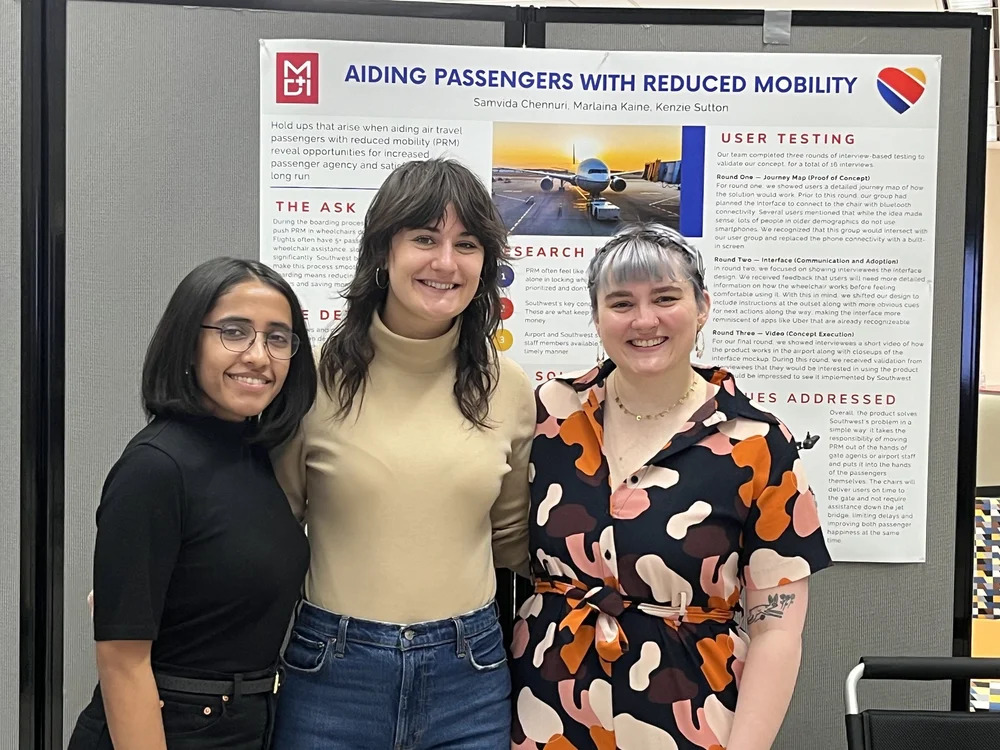

Marlaina Kaine (pictured on right with two of her capstone classmates) helped design a prototype for a wheelchair with a suitcase attachment. Photos courtesy of Marlaina Kaine
“When we finished our presentation, and Southwest asked if we could send our research to them, I was like, ‘Wow, they really care about the work that we put in,’” Kaine says. “It definitely felt like it was a meaningful problem that they really wanted to hear about.”
Unlike Murdock, Kaine didn’t opt for the private sector — she entered the municipal space, another realm that is actively seeking design and innovation thinkers who prioritize empathy and creativity.
“People are talking about human-centered design in a lot of government circles because it shows the ways that how something looks on paper is not usually how it works in practice — and that is the universal truth of government processes,” says Kaine, whose MD+I training proved a big asset to her team. “I was able to do these qualitative interviews with residents and draw insights, and communicate those to a group about what was happening, so that we could redesign what we’re working on to fit the actual outcome.”
Kaine enjoyed her time in government, but when the opportunity came to return to Wisconsin and work for Milwaukee Tool, it was too good to pass up.
“I’m really excited about it,” says Kaine.
Tools for better design
Milwaukee Tool’s Wenzel first encountered MD+I a couple years ago when she came and spoke to Watt’s class. She was impressed enough with the student presentations that, down the road when applications from MD+I alum crossed her desk, she took note.
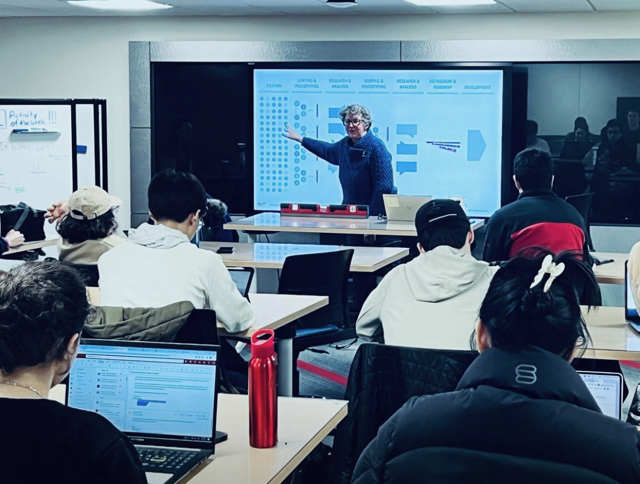

Liesbeth Wenzel pictured at right and teaching an MD+I class. Photos courtesy of Wenzel
“Our researchers go out and spend a lot of time on job sites interviewing users, watching what they’re doing,” says Wenzel, who helms a design research team of 20 within the larger front-end innovation team. “We’re here to uncover opportunities that aren’t obvious. If you just go and ask a consumer or a user what they need, they won’t tell you the thing that they don’t know that they need.”
This is where human-centered design thinking comes in, and what makes MD+I grads so valuable, as evidenced by the fact that Wenzel has now hired three.
“When you find someone who has that sort of graphical ability to see things in space, along with a real understanding and sensitivity to other people, it’s a magical combination,” Wenzel says. “It takes a certain kind of person to think this way.”
Wenzel also has a design degree, along with archeology — and she comes from a family of liberal arts professors.
“Obviously there’s a big push towards STEM, engineering and technical fields, and I’ve seen a falling away of appreciation for the liberal arts degrees,” Wenzel says. “But I think they’re more important than ever.”
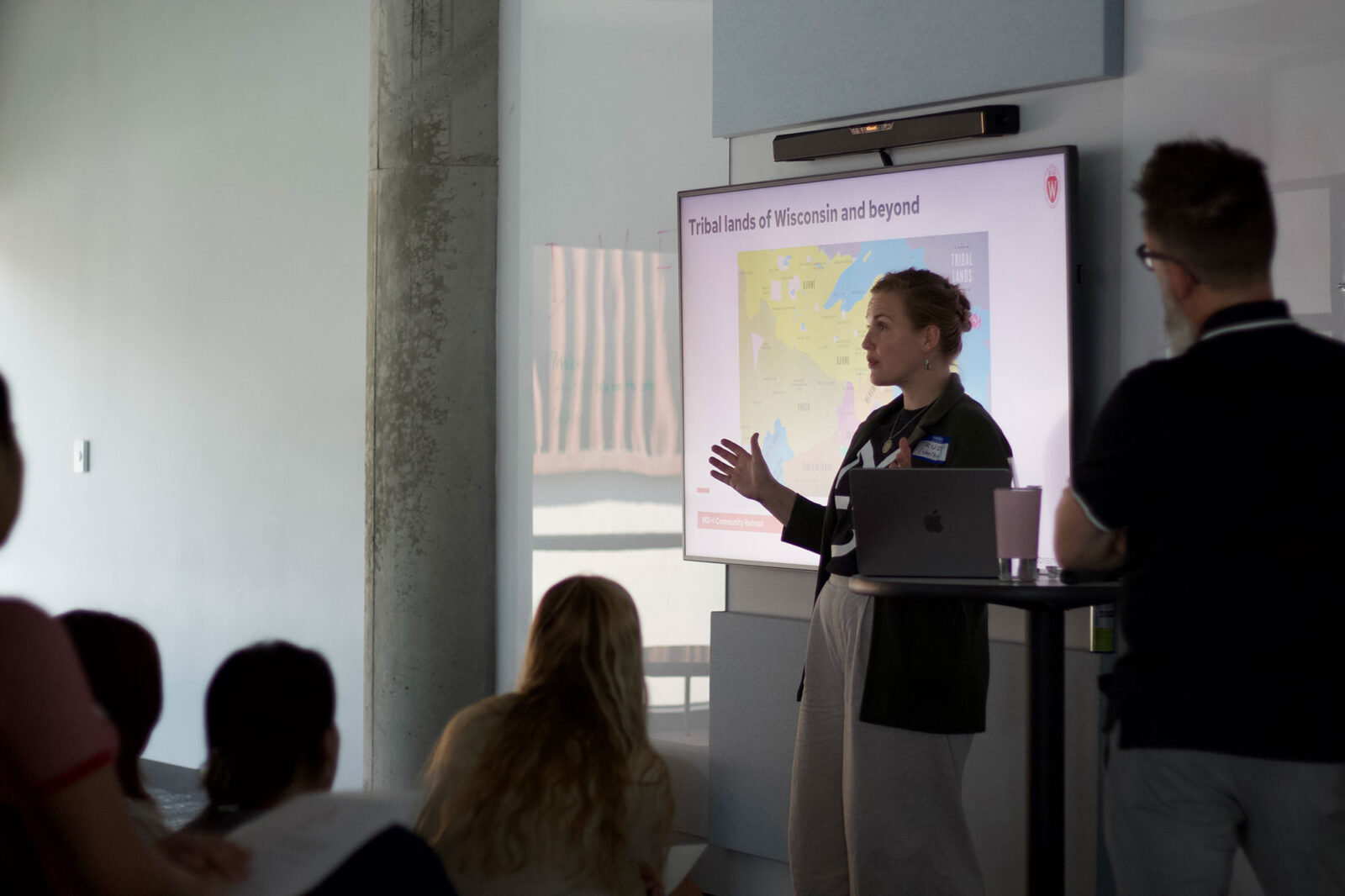
“It’s a mistake to underestimate the power of creative practice, whether that’s in design or in art,” Watt says.
Trudy Watt teaching. Photo courtesy of Coe Douglas
Watt believes this, too — and she also took a nontraditional path to academia, working in architecture and landscape architecture for about ten years before entering graduate school at nearly 30 years old, and then opening her own design firm. This mix of professional and educational backgrounds, real-world experience, and outside-the-box creative thinking is reflected in MD+I’s approach — and it’s a timely one.
“It’s a mistake to underestimate the power of creative practice, whether that’s in design or in art,” Watt says. “And if the apple cart is upside down for everyone, including the jobs that historically had the most certainty and stability — if we have to rethink everything — then ask the creative people to be part of the rethinking process.”
No wonder Watt favors that metaphorical image of hallways giving students access to so many rich resources on campus. The university is a place where all things seem possible. MD+I students gain outside-of-the-box tools for creatively solving problems they don’t even know about yet.
“Design has a foot in the world of art, in the world of business, and in the world of engineering, and I think that Lucy’s and Marlaina’s stories really illuminate what it looks like when a student successfully leverages that kind of multihyphenate identity of the designer in the world,” Watt says.
Maybe they’ve found those identities in Engineering, or Art, or Business, or Computing and AI, or Human Ecology — maybe from all five, and beyond. Wherever it is they’re coming from, one thing seems clear: All of the magical hallways lead back to MD+I.