Flow State
Design students weave together the state’s waterways, two cultural tours, and the Wisconsin Idea to create the textile gifts that keep on giving.
By Maggie Ginsberg, Division of the Arts, with Lauren Goulette
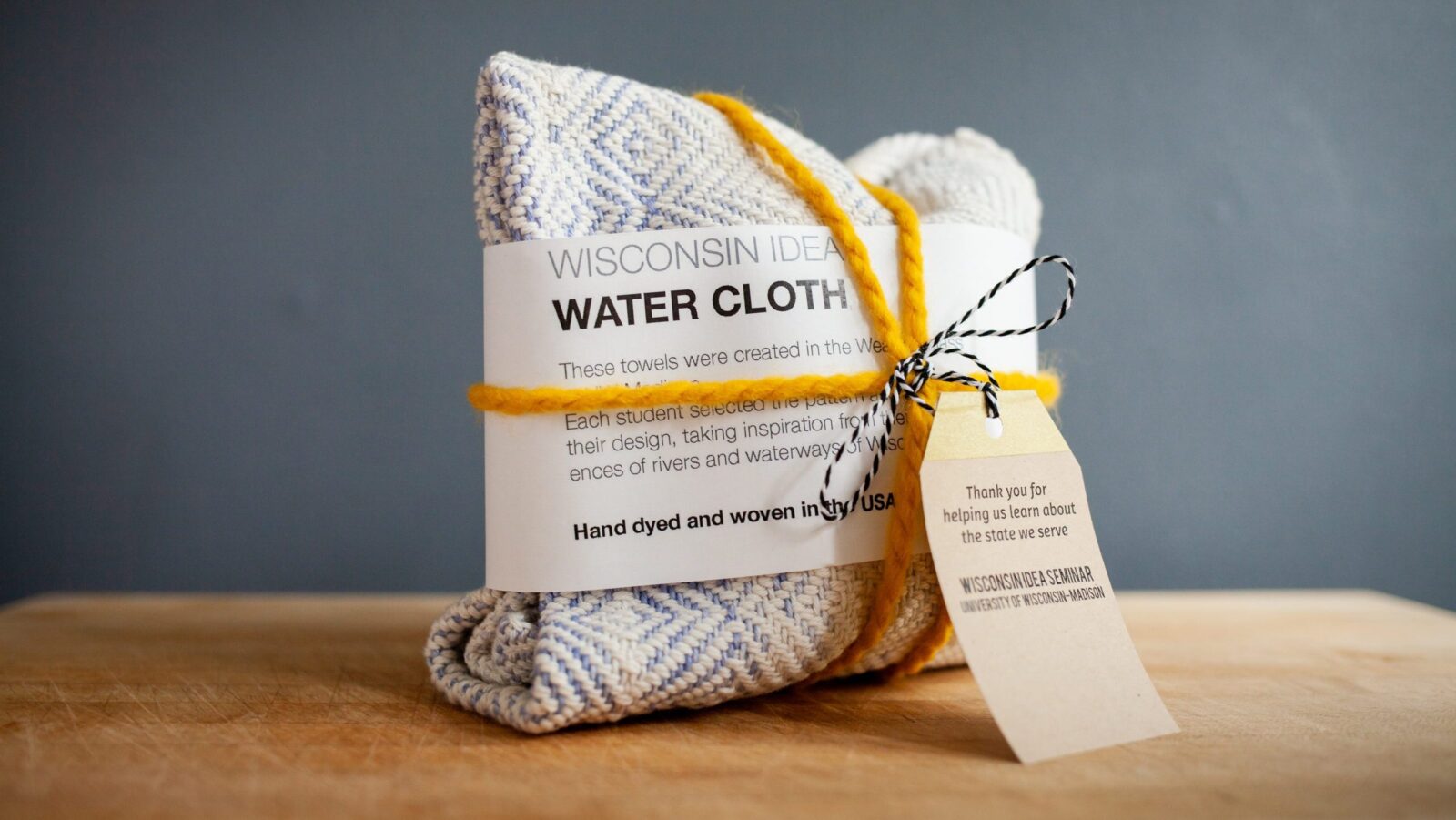
This is a story about water.
Deep underground, thousands of years of glacial melt joined with thriving watersheds and steady rain to fortify Wisconsin’s aquifers. Layers of silt and gravel held the groundwater that fed the grasses that nourished the sheep that wore the wool. Shorn, spun, and berry-dyed, the fibers threaded through generations — some landing, ultimately, on the looms inside Professor Marianne Fairbanks’ weaving studio.
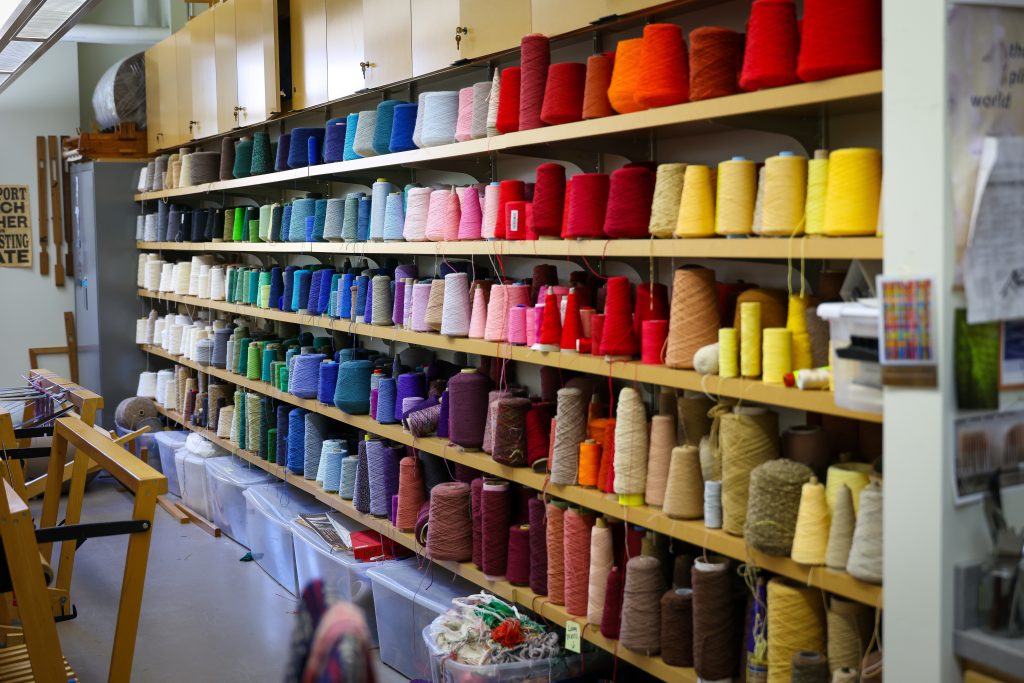
Today, in that window-lined room on the fifth floor of Nancy Nicholas Hall, Fairbanks’ design students are working on a special textile project known as “water cloths.” Against a backdrop wall of shelves rainbowed with vibrant thread in every hue, the students float “round robin” style from loom to loom, trying out different structures and techniques. They’ve enrolled in this lab expecting to learn the ins and outs of warp and weft. They probably weren’t expecting to get a deep dive on Wisconsin’s waterways or to look at familiar campus locations through Indigenous perspectives — nor to find themselves playing an integral role in a larger tradition called the Wisconsin Idea Seminar.
“This is a beautiful, curricular way we’ve found to connect students directly into the Wisconsin Idea,” says Fairbanks, who was inspired to design the water cloth curriculum after participating in the Wisconsin Idea Seminar in 2015.
The Wisconsin Idea Seminar is an annual five-day bus tour across Wisconsin that offers UW–Madison staff and faculty the opportunity to learn from farmers, environmental stewards, tribal leaders, business owners, and artists. At each stop, program director and Assistant Vice Provost Catherine Reiland presents each collaborator host with a gratitude bundle of handmade products that tell stories of Wisconsin.
Years ago, after Fairbanks participated in the tour, she reached out to Reiland with an idea: What if she created a curriculum that gave students the experience of designing, creating, packaging and selling water cloths to the tour for its gratitude bundles? Reiland immediately recognized the synergy — she’d long been searching for a meaningful way to express gratitude to seminar hosts and collaborators.
“My desire for tangible expressions of gratitude were answered in Marianne’s teaching goals — guiding her students through technical, practical, entrepreneurial, intellectual and theoretical frameworks of weaving,” says Reiland.
Now the students’ textiles have become a highlight of the tour.
“Hosts have been really moved by receiving the water cloths,” says Reiland. “So much of the Wisconsin Idea Seminar is about context, and the root of the word ‘context’ is ‘to weave.’ What’s more, each year’s seminar journey is shaped and informed by water. So, for me, the water cloth project is the perfect embodiment of the seminar.”
WEAVING IT ALL TOGETHER
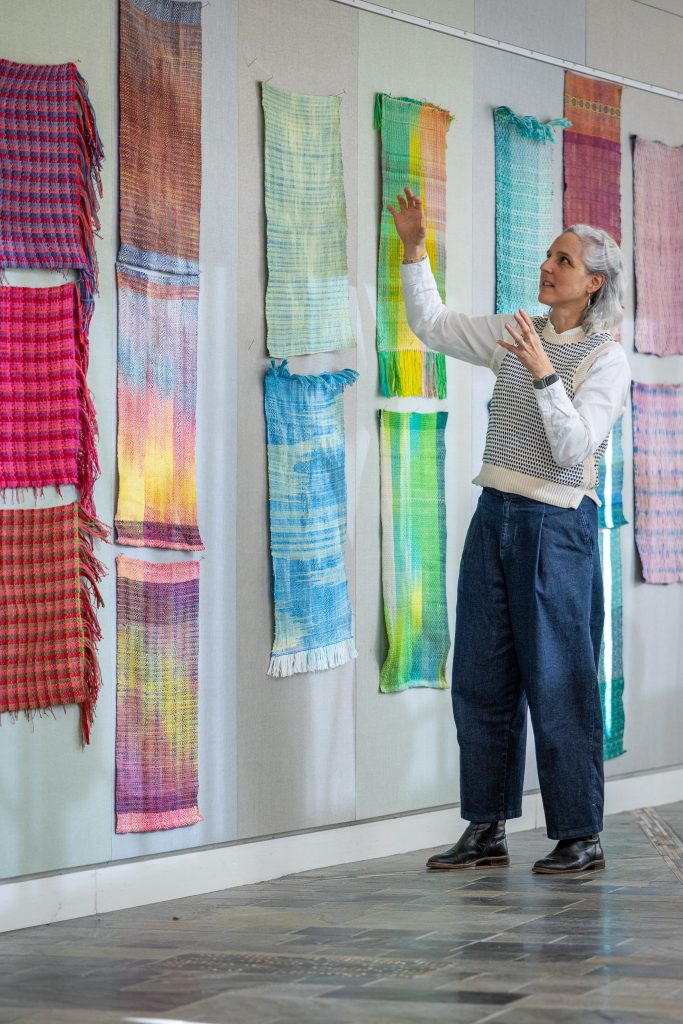
Part of why the Wisconsin Idea Seminar resonated with Fairbanks is that she always wants her design students to think deeply about people and place, too. She wants them to draw inspiration from the natural landscape and its stewards, then carry that through when designing, crafting, packaging and positioning their textiles in the world.
That’s why, within the first few weeks of the water cloth course, Fairbanks takes her students on a different tour, this one much closer to home: the First Nations Cultural Landscape Tour, a campus walking tour exploring the ancestral Ho-Chunk land occupied by UW–Madison.
“I think every student who steps foot on this campus should go on the First Nations Cultural Landscape Tour,” says Fairbanks, who also encourages students to spend time sitting in reflection at various shores throughout campus to reflect on notions of interconnectedness and ethical responsibility. They spend a lot of class time discussing things like sustainable sourcing, natural dying techniques, socioeconomic factors, and how interconnected all of these things can and should be. Students create two water cloths — one to keep and one for the Wisconsin Idea Seminar — resulting in a beautiful, meaningful, useful representation of the way Wisconsin’s water flows through, shapes, and feeds everything.
“As a curricular integration, it’s so fantastic, because it’s laying the groundwork and helping them understand how their work relates to other people,” Fairbanks says. “They’re mining their own memories and inspirations around water, but then they’re learning the histories and designing this very utilitarian object for people all around the state.”
AN UNEXPECTED EXPERIENCE
Delaney Rehmus, a junior majoring in Textiles & Fashion Design, says the water cloth experience turned out to be an unexpected gift in itself.
“I was excited to explore something beyond just a normal project for a portfolio, but I wasn’t aware of the depth of it, and what we would be entitled to create,” says Rehmus. “I’ve always appreciated the lakes, and I’ve lived by water my whole life, but now I think about it a lot deeper. I appreciate my state more. And I hope to make other people appreciate it more, too, and think a bit deeper about the denim or knits they have on their body.”
By contrast, design student Maile Chan grew up in Portland. There was so much she didn’t know about Wisconsin until she took Fairbanks’ course, and that new knowledge became an integral part of her design.
“I drew inspiration for my water cloth from Wisconsin’s sea caves, because they’re such an unexpected gem, and something I wasn’t aware of,” Chan says.
Some students use the water cloth project as a creative jumping off point to push themselves even further in design, even participating in the class more than once.
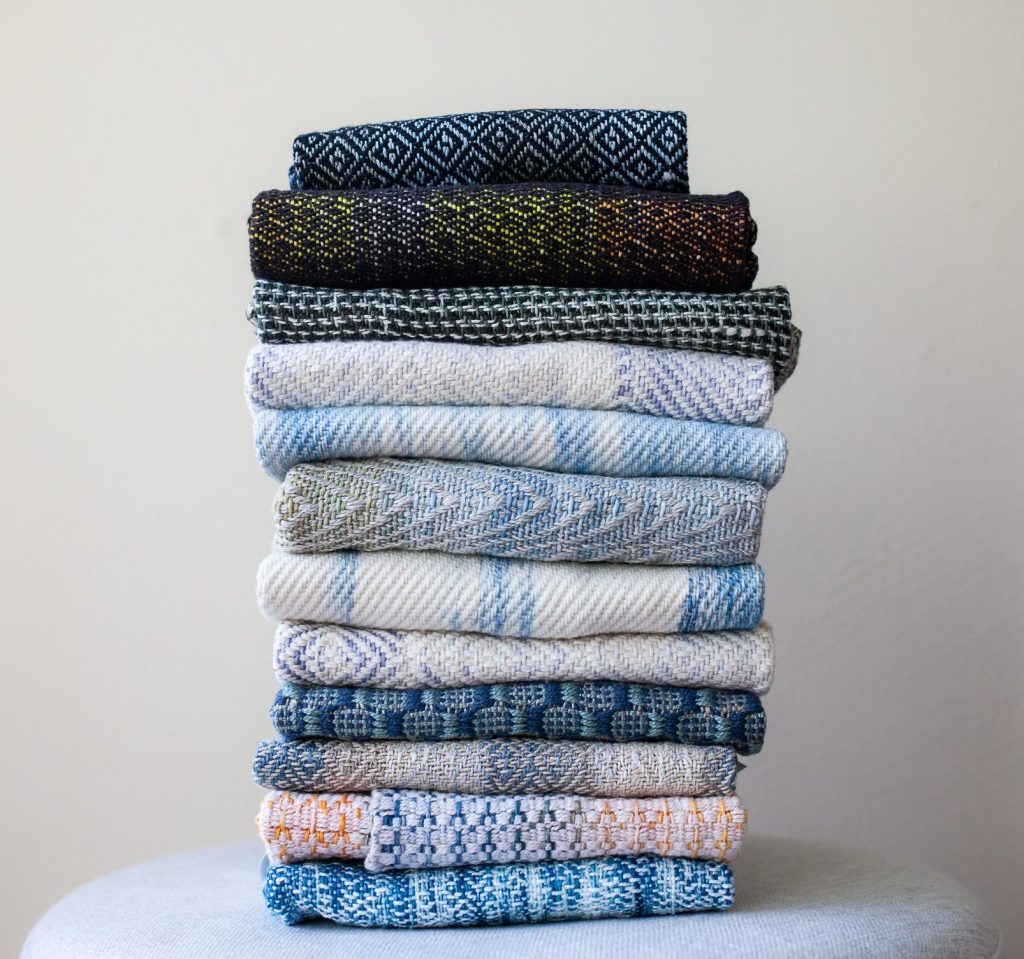
“This is my fourth semester of weaving, and we were required to do two towels, but I did four, and I wanted to be very experimental,” says senior Matthew Lyga, who appreciates the logic, math, and engineering underpinning the creative aspects of the artform. Lyga played with numerous techniques including waffle weave and twill that might come in handy on their senior thesis, but the ones destined for the tour are just as meaningful.
“It’s really cool that somebody out there is using that towel, and they’ve never met me, I’ll probably never meet them, and I’m never going to see that towel again,” Lyga says, “but it exists.”
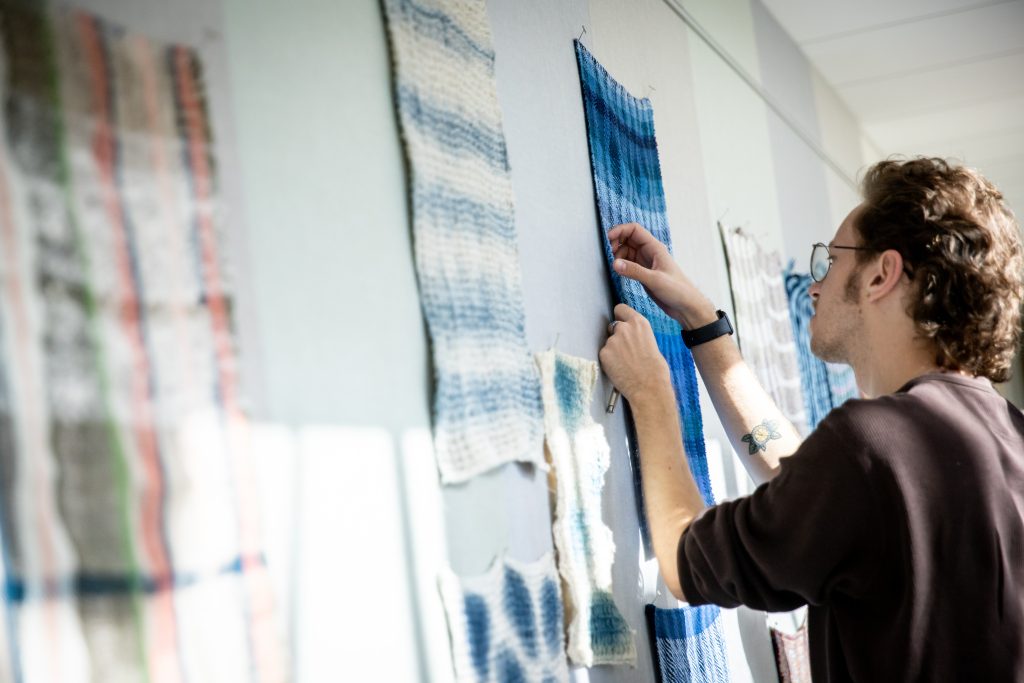
Kyla Moore, a junior double majoring in Textiles & Fashion Design and Music Performance, also took the opportunity to try something new, and with a different twist on the water theme.
“I decided to be extra and combine a different art called Shibori, which is a Japanese dying process similar to tie-dye where you get these shapes that are very wave-like,” says Moore, who lives close to
James Madison Park and used the endless photos of watery sunsets on her camera roll to select her colors. ”It’s kind of like opening a present at the end when you get to see the organic waves, and then it literally became a present, so that’s pretty awesome.”
Moore likens the water cloths project to the gift-giving economy she read about in the bestselling books by UW–Madison alumna Robin Wall Kimmerer (MS’78, PhD’83), a Potawatomi botanist and author.
“I think a lot of the time when we talk about the Wisconsin Idea, it’s a send-off in an email, or it’s opening up the start of an event, but it’s not as ingrained into our class culture,” Moore says. “I hadn’t really even known that it was something I could experience in a class in such a meaningful way. I really love that this work that I love was able to serve as a gift to somebody else for them to love. I think that sort of circle of receiving from our environment is the healthiest way for everybody to coexist.”
LASTING EXPRESSIONS OF GRATITUDE
For Reiland, the water cloth project has provided a meaningful way for her to express gratitude to Wisconsin Idea Seminar collaborators and hosts. The ability to financially support local, student-driven textile art by purchasing the water cloths, and then turning around and presenting them to seminar collaborators, is deeply powerful.
“We never know exactly how the work we do will touch people or inspire people into the future,” Reiland says. “I think for all of us, there’s joy that the water cloths bring to everyone who is part of the project.”
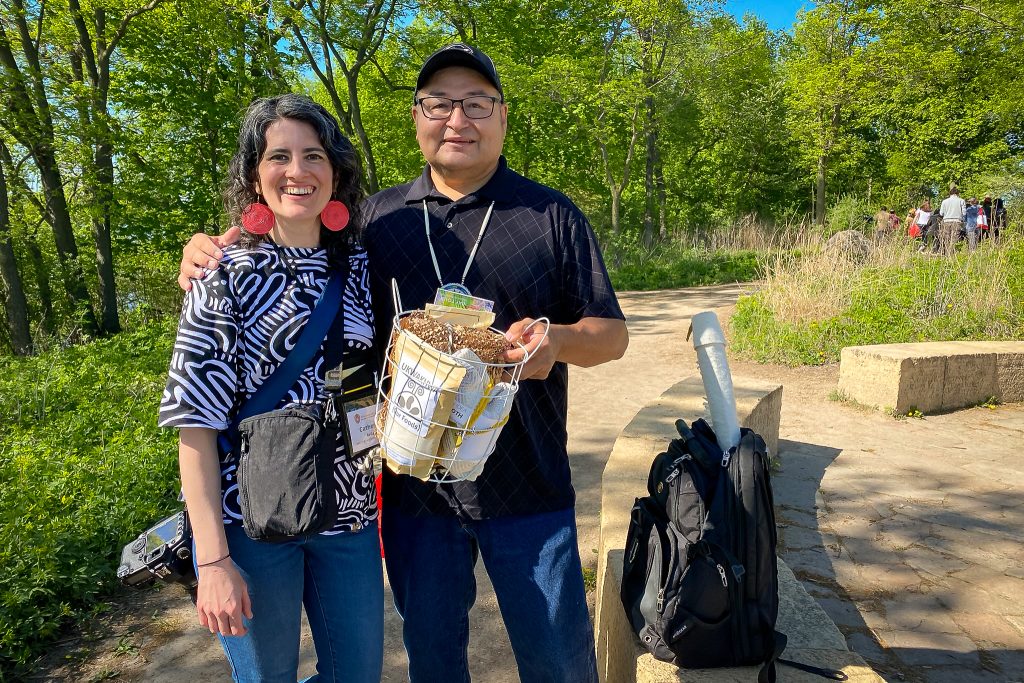
All of this is why Fairbanks and Reiland believe that crafting and sharing student-made water cloths is the perfect way to connect with Wisconsin at its roots. The same roots that tap the water to grow the grasses that nourished the sheep that wore the wool, now woven and hanging in the homes of the many people who make Wisconsin what it is.